The Bee Exercise

Photo by PK Gupta on Pexels.com

Fairly often when I sit on the balcony, a few bees come flying by. They move around, hover over the table, bump into the windows. And sometimes they come close to me. Too close for my inner radar.

Over the last couple of times, observing this relationship between the bees’ position and my position became an interesting exercise. The closer a bee gets, the louder this inner radar screams. Almost as if there was a linear (or maybe exponential) relationship between the two. The bee gets closer, discomfort increases, fear increases, aversion increases. Thoughts start concentrating on the bee, wanting it to move away. If the bee gets too close, or if it brushes its wings against my skin (physical touch is not strictly necessary: just the displaced air is enough), the aversion becomes so intense (even if for just a moment) that a physical action involuntarily bursts up: I wave my hand in a dismissive movement so that the bee flies away. Very hard to control. Very hard to even just observe.

Bees are not going to attack me by default. That’s not their intention. They are not against me, and they don’t mean harm when they fly close by. But years of learned behavior, of seeing others react like that, and of hypothesizing how painful a bee sting can be have built this reaction mechanism in my mind. It’s automatic now: the closer a bee is, the louder my mind screams. I don’t need to think about it, and I cannot turn it off.

So much so with other aspects of life. How many figurative bees are out there? People, situations, noises, emotions to which we have internalized specific, automatic reactions, and that lead us to a life of reactions rather than mindful actions. As when observing my thoughts and behavior in relation to a bee, may I be sensitive enough and learn to observe my thoughts and behavior in relation to the many events and people that come in contact with me through my life.
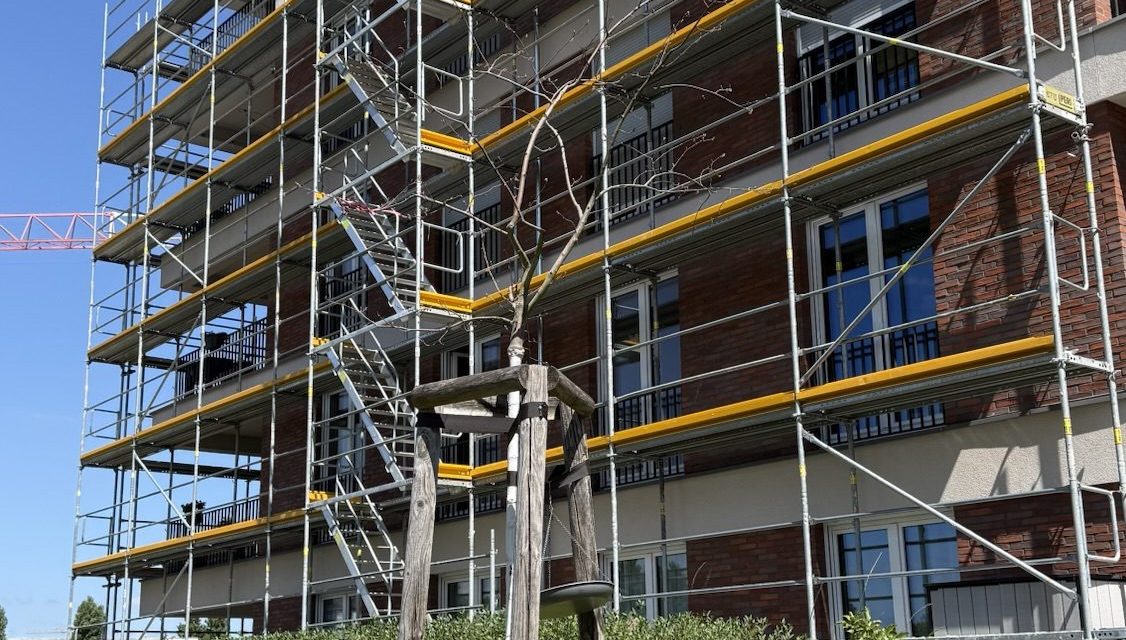

Now We Always Close the Windows

Over the last couple of weeks, there was a renovation going on at the last floor of the building where we live. Something related to water infiltration. On the first day after the metal scaffolding was assembled, it felt uncomfortable: people walking by the windows, even though we live on the second floor. A warning from our landlord: there’s a higher risk of theft as well. The first days when the building was surrounded by this metal structure surely felt different, unnatural. We closed the windows and brought down the shutters consciously, and our life became a little more constrained because of that: less light, less fresh air, less freedom in a general sense.

And so the days and weeks passed. And closing the windows came more naturally.

And less light became the norm. And less freedom became the norm. This new construct that was not there in the first place became the new standard for our home, and we took all the limitations it imposed as now a natural part of our lives.

How often is this mechanism active? How often do we take such constructs, not around our buildings, but around our lives, around our behavior, around our society, and internalize them as “the way life is”? And so we lose our light, we lose our fresh air, we lose our freedom, ever so slowly, ever so imperceptibly, little by little.

May we become aware of the bondages and attachments that bind our lives. And may we attain the wisdom to let them go.

On Paths, Defaults, and Convergence

Photo by Krista Glu012bzdeniece on Pexels.com

A few hours ago, my partner and I were talking about life choices and careers. I’m in the middle of changing mine. She is in the middle of changing hers. We both have dreams, aspirations, fears, hesitations, attachments, aversions. We both have boiling kettles in our subconscious, and sometimes we get a glimpse of how agitated our minds are. Amidst this agitation, it is easy to lose ourselves, to lose focus, and to ignore true understanding. When a boat is navigating an angry sea, the first instinct of the passengers is just to manage to stay on board.

One sentence was voiced during our conversation, in a most casual tone: “I’m afraid of defaulting, converging to the old me.”

And with this we sat for some time. Is defaulting really the same as converging? If anything, they are the complete opposite. One defaults to known patterns, known behavior, safe environments, habitual patterns of the mind. This is not convergence. One converges towards one’s true calling, love, a harmonious life, a free mind. Convergence is a process that takes time and effort to happen. Convergence is a process that requires learning (so many people like to call this “failures”, don’t ask me why 🤷‍♂️), patience, self-exploration and awareness, kindness and self-love, permission to try, permission to change your mind, permission to explore new paths. It is a process that requires accepting uncertainty, sitting with it for days, weeks, months, perhaps a lifetime (this I will be able to tell you only when I approach the end of mine). Convergence is for sure harder and more painful than defaults. But as the saying goes, “Did you know that, very often, the hard thing to do and the right thing to do are the same?”

May we all learn and experience the difference, for true understanding comes only through one’s own experience, and may we all achieve liberation from our defaults.