The Bee Exercise

Photo by PK Gupta on Pexels.com

Fairly often when I sit on the balcony, a few bees come flying by. They move around, hover over the table, bump into the windows. And sometimes they come close to me. Too close for my inner radar.

Over the last couple of times, observing this relationship between the bees’ position and my position became an interesting exercise. The closer a bee gets, the louder this inner radar screams. Almost as if there was a linear (or maybe exponential) relationship between the two. The bee gets closer, discomfort increases, fear increases, aversion increases. Thoughts start concentrating on the bee, wanting it to move away. If the bee gets too close, or if it brushes its wings against my skin (physical touch is not strictly necessary: just the displaced air is enough), the aversion becomes so intense (even if for just a moment) that a physical action involuntarily bursts up: I wave my hand in a dismissive movement so that the bee flies away. Very hard to control. Very hard to even just observe.

Bees are not going to attack me by default. That’s not their intention. They are not against me, and they don’t mean harm when they fly close by. But years of learned behavior, of seeing others react like that, and of hypothesizing how painful a bee sting can be have built this reaction mechanism in my mind. It’s automatic now: the closer a bee is, the louder my mind screams. I don’t need to think about it, and I cannot turn it off.

So much so with other aspects of life. How many figurative bees are out there? People, situations, noises, emotions to which we have internalized specific, automatic reactions, and that lead us to a life of reactions rather than mindful actions. As when observing my thoughts and behavior in relation to a bee, may I be sensitive enough and learn to observe my thoughts and behavior in relation to the many events and people that come in contact with me through my life.

Now We Always Close the Windows

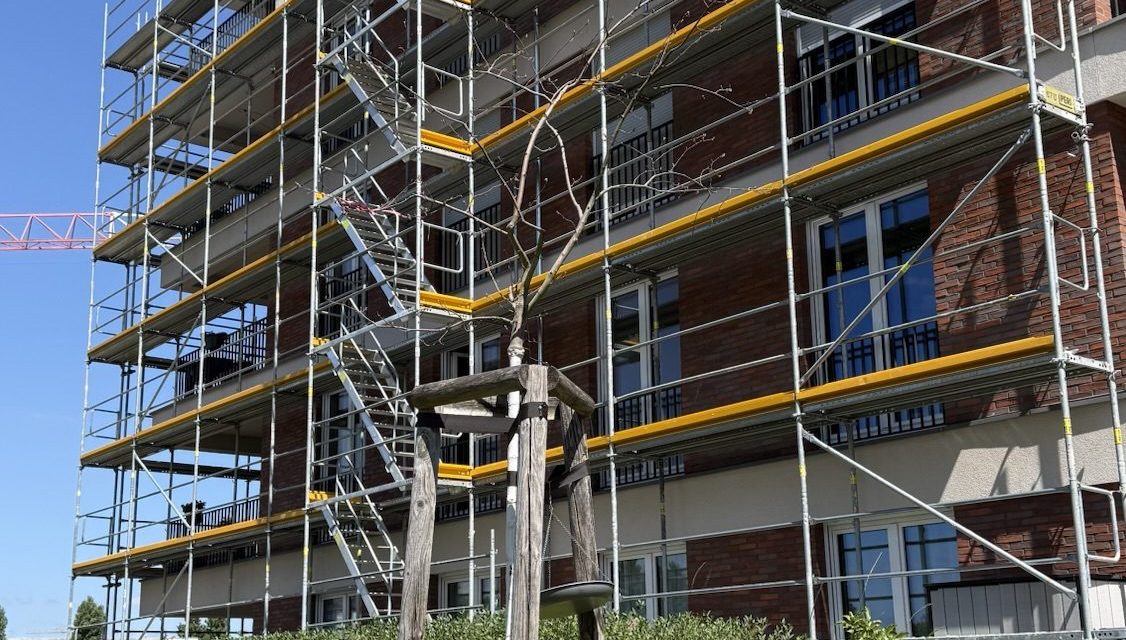
Over the last couple of weeks, there was a renovation going on at the last floor of the building where we live. Something related to water infiltration. On the first day after the metal scaffolding was assembled, it felt uncomfortable: people walking by the windows, even though we live on the second floor. A warning from our landlord: there’s a higher risk of theft as well. The first days when the building was surrounded by this metal structure surely felt different, unnatural. We closed the windows and brought down the shutters consciously, and our life became a little more constrained because of that: less light, less fresh air, less freedom in a general sense.

And so the days and weeks passed. And closing the windows came more naturally.

And less light became the norm. And less freedom became the norm. This new construct that was not there in the first place became the new standard for our home, and we took all the limitations it imposed as now a natural part of our lives.

How often is this mechanism active? How often do we take such constructs, not around our buildings, but around our lives, around our behavior, around our society, and internalize them as “the way life is”? And so we lose our light, we lose our fresh air, we lose our freedom, ever so slowly, ever so imperceptibly, little by little.

May we become aware of the bondages and attachments that bind our lives. And may we attain the wisdom to let them go.

On Paths, Defaults, and Convergence

Photo by Krista Glu012bzdeniece on Pexels.com

A few hours ago, my partner and I were talking about life choices and careers. I’m in the middle of changing mine. She is in the middle of changing hers. We both have dreams, aspirations, fears, hesitations, attachments, aversions. We both have boiling kettles in our subconscious, and sometimes we get a glimpse of how agitated our minds are. Amidst this agitation, it is easy to lose ourselves, to lose focus, and to ignore true understanding. When a boat is navigating an angry sea, the first instinct of the passengers is just to manage to stay on board.

One sentence was voiced during our conversation, in a most casual tone: “I’m afraid of defaulting, converging to the old me.”

And with this we sat for some time. Is defaulting really the same as converging? If anything, they are the complete opposite. One defaults to known patterns, known behavior, safe environments, habitual patterns of the mind. This is not convergence. One converges towards one’s true calling, love, a harmonious life, a free mind. Convergence is a process that takes time and effort to happen. Convergence is a process that requires learning (so many people like to call this “failures”, don’t ask me why 🤷‍♂️), patience, self-exploration and awareness, kindness and self-love, permission to try, permission to change your mind, permission to explore new paths. It is a process that requires accepting uncertainty, sitting with it for days, weeks, months, perhaps a lifetime (this I will be able to tell you only when I approach the end of mine). Convergence is for sure harder and more painful than defaults. But as the saying goes, “Did you know that, very often, the hard thing to do and the right thing to do are the same?”

May we all learn and experience the difference, for true understanding comes only through one’s own experience, and may we all achieve liberation from our defaults.

Browser tabs and life

More often then not I find myself browsing through an infinite amount of open tabs in my browser, looking for that one where the information actually is. Reading an article ends up adding five or six of them to the collection. Participating in a call at work adds another three or four with links shared for later reading. Multiple windows start to pop up when there isn’t enough space in the current one. All that stays around for days, even weeks, without ever being read. Without ever being finished. Many hanging threads, hanging only by the hope that one day motivation will dawn on me and I’ll finally read that documentation page that I don’t even know why it’s open anymore.

If, and I stress, if the pattern stayed with browser tabs, I wouldn’t think much of it. But when I switch off from work and move to other personal activities and hobbies, I very quickly find myself surrounded by unfinished things. Article ideas composed only of a title, a momentary inspiration crystallized for later expansion. Video and online course ideas composed only of a tiny outline, only to be forgotten as tomorrow another idea takes their throne. So many unfinished activities, so many undernourished ideas.

The main reasoning for this behavior is the “the idea must be captured now and later on it can be expanded” fallacy. A fallacy, yes, because I never get to the “expanding” part, I’m always busy capturing. Capturing ideas is quick, our minds are full of them. Expanding them is hard work, and not always rewarding. So very often I find that dedicating time to a single activity quickly becomes repetitive and not as exciting as the promise in my imperfect imagination was. The details of making mistakes, of not having enough background knowledge to hold a convincing argument, of just running out of ideas are left out by my sneaky brain. That’s how the brain works, after all: it abstracts details and it fails to create a realistic picture of how a certain mental model will later be translated into reality. We can all visualize a 5-Dollar (or Euro, or whatever the currency of our countries is) bill to perfection in our minds; it’s only when we try to draw them in reality that we realize how much our brain has left out, how many gaps and details were left unfilled.

Not spending time to work on these ideas prevents me from entering this ambiguous, sometimes discouraging territory. It protects me from disappointment through an elaborate thought process and addiction to filling rows in my tables of ideas only so that I can tap myself on the back and convince myself that I am productive. This is not how I want my life to be. I’m tired of just conceptualizing promises to myself, of only writing promises of work that will never be finished. I’m tired of opening tabs, never to read them.

Six years

Or almost, with the last post dating from 2016.

I was reminded of this blog by a moderation email for a new comment. Visiting these pages and re-reading these thoughts brought so much back. They are still so relevant for me, but forgotten. Not really forgotten, but suppressed. Life caught me with its little worries, with its little urgencies. A deadline for work, a project for university, futilities here, futilities there. At the end of the day, too tired to write. Too tired to think. Too tired to realize I’m distancing myself from what I value.

I recently moved in with my girlfriend. We bought a bed with four drawers under it, so that we can keep some stuff which we don’t use very often away from sight. The result? Most of the possessions are there not because we don’t use them very often, but because we don’t know what to do with them. “What do we do with these shoes?” “Hmm, not sure. Just put it under the bed.” “What do we do with these boxes?” “Just put it under the bed!” Instead of properly thinking about what should be done (perhaps donate the clothes and throw away the boxes?), we just put them all under the bed.

I have done the same with my thoughts. As seemingly more important commitments started to consume my time, I started putting thoughts away, deferring them. They crossed my mind often but I didn’t have time for them. I didn’t have time to properly examine them, to dialogue with myself and with books. Perhaps I had the time, but lacked the maturity. Probably. Probably I still lack it.

Six years is a long time. In six years a newborn learns to walk, to talk, some even to read. Adolescents go through their entire high school, and some even through university. Grown-ups change jobs, change cities, change aspirations. Parents become grandparents, grandparents become memories.

But people also move backwards. Some relapse into bad past habits. Some break ties with family members or friends. Some make empty promises of change, only to fool themselves and others that there is movement, that there is progress in their lives. Some get caught in the little concerns and the little urgencies of life.

Six years is a long time. I wonder where I would be if I had dedicated enough attention to my thoughts during all this time. Perhaps I would have followed a different career. Perhaps I would already have some of the answers I still look for. Perhaps I would have found inner peace.

Well, perhaps it’s time to open the drawers again.

About caged birds and thoughts

A few days ago I attended to a TEDx event. I was among the first wave of curious people walking down the hall and taking a small cupcake from the trays on the tables. A comfortable seat seemed to whisper my name, so I attended the call and reclined myself against the wall.

What I observed was exactly what I expected: phones and conversations. People were either on their phones or talking to someone else. I won’t say I was shocked, because I’ve seen this behavior so many times that somehow I got used to it.

Continue reading “About caged birds and thoughts”